
Cabarrus County City Directory Runs
Confirmed Cabarrus County city directory material centers on Concord, not on a single uninterrupted countywide series. DigitalNC and the UNC North Carolina Collection identify individual scans from 1902 through selected 1960s years. Their metadata names the publisher for several volumes and gives each item its own record. That matters because a cataloged run is evidence for a particular year, not proof that every year in between was printed or survives. The Concord Library's Lore Room is the local starting point for material that is not online, while DigitalNC is the clearest confirmed digital route for the volumes listed below.
| Collection | Years | Publisher | Where held | Access |
|---|---|---|---|---|
| Concord directory | 1902 | Inter-State Directory Company | DigitalNC and UNC North Carolina Collection | Free item scan and metadata |
| Concord item runs | 1908, 1913-14, 1916-17 | Verify by individual record | DigitalNC and linked collections | Digitized, item-specific |
| Concord directories | 1920-21, 1922-23, 1924-25 | Piedmont Directory Co., Ernest H. Miller | DigitalNC and UNC links | Free digitized items |
| Concord editions | 1933, 1936, 1938, 1940, 1942, 1946 | Baldwin Directory Company for named Baldwin editions | DigitalNC | Verify the individual volume |
| Hill's Concord | 1949, 1952-55, 1957, 1959, 1962-64 | Hill's | Established genealogy metadata and scans | Item-specific access |
| Lore Room local material | Back to 1750 | Not a directory series | Concord Library | Books, microfilm, folders, walk-in or appointment |
The table is a working shelf list, not a promise of continuous coverage. A 1933 Concord item expressly includes West Concord and homes adjoining the city limits, which shows why a city title can cover more than the municipal core. Separate web-indexed material also identifies a 1964-65 Hill's Kannapolis volume and older county business, professional, farmer, and manufacturing directories. Check the title page and repository record before treating any of those as a general household directory.
Start with the 1902 Concord directory record at DigitalNC when an early name is known.
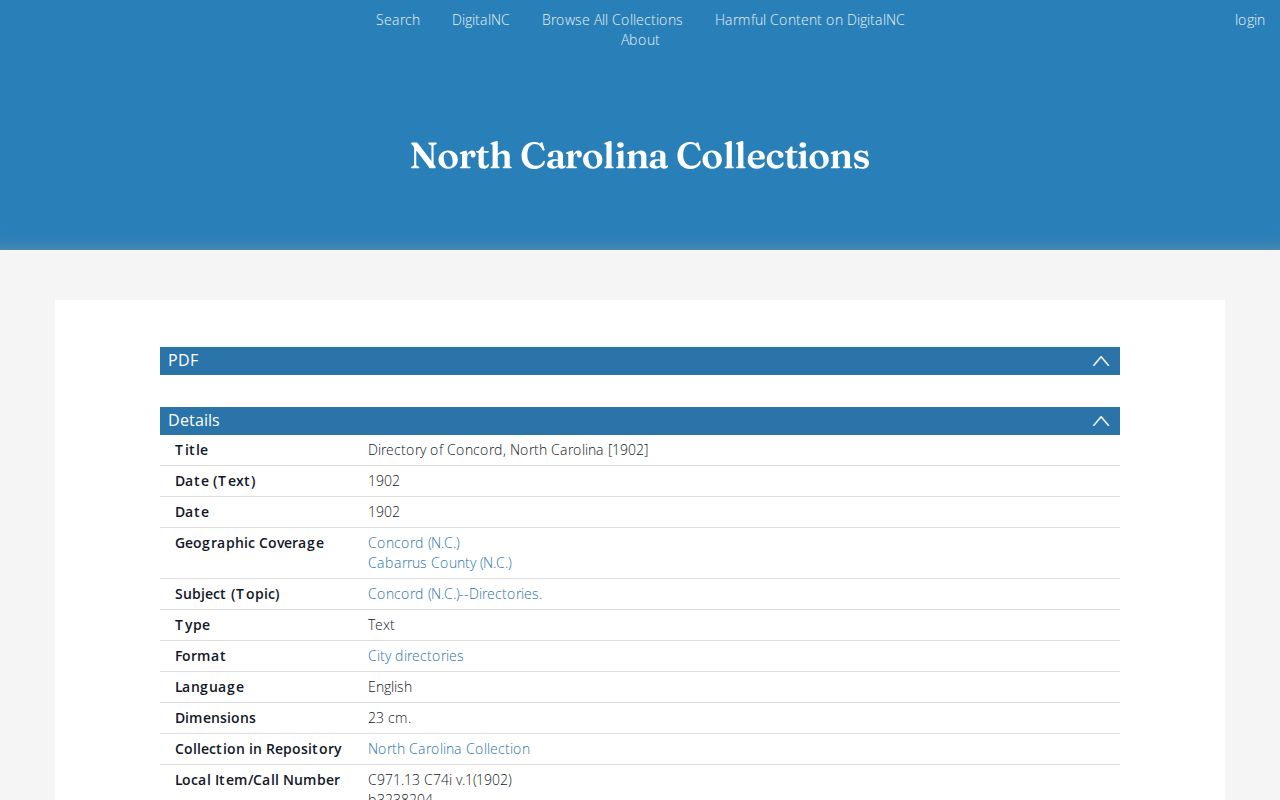
The record supplies the Inter-State Directory Company attribution and keeps the year tied to a specific digitized item rather than to an assumed run.
Cabarrus County Directory Publishers
The surviving Concord series changes hands over time. The 1902 volume is credited to Inter-State Directory Company. The 1920-21, 1922-23, and 1924-25 volumes are Piedmont Directory Co. publications associated with Ernest H. Miller. Later named editions include Baldwin's and Observer's Concord in 1936, Baldwin's volumes in 1938 and 1940, master editions in 1942 and 1946, and selected Hill's volumes after that. Publisher names can help distinguish similar titles in a search result, especially when a year has more than one edition or scan.
| 1902 | Inter-State Directory Company Concord volume |
|---|---|
| 1920s | Piedmont Directory Co. runs credited to Ernest H. Miller |
| 1930s-1940s | Named Baldwin and Observer's editions, including master editions |
| Later selected years | Hill's Concord volumes through 1962-64 and a 1964-65 Kannapolis item |
Use the publisher as one search term, then compare the scan's publication page with the catalog metadata. A directory may have been gathered months before printing, so it is a dated snapshot rather than a complete account of every person in Concord or Cabarrus County at that moment. The research did not verify a definitive first printed directory or a final printed year. It is more accurate to name the confirmed items than to claim an unbroken series.
The 1920-21 Concord directory record shows the Piedmont Directory Co. attribution.
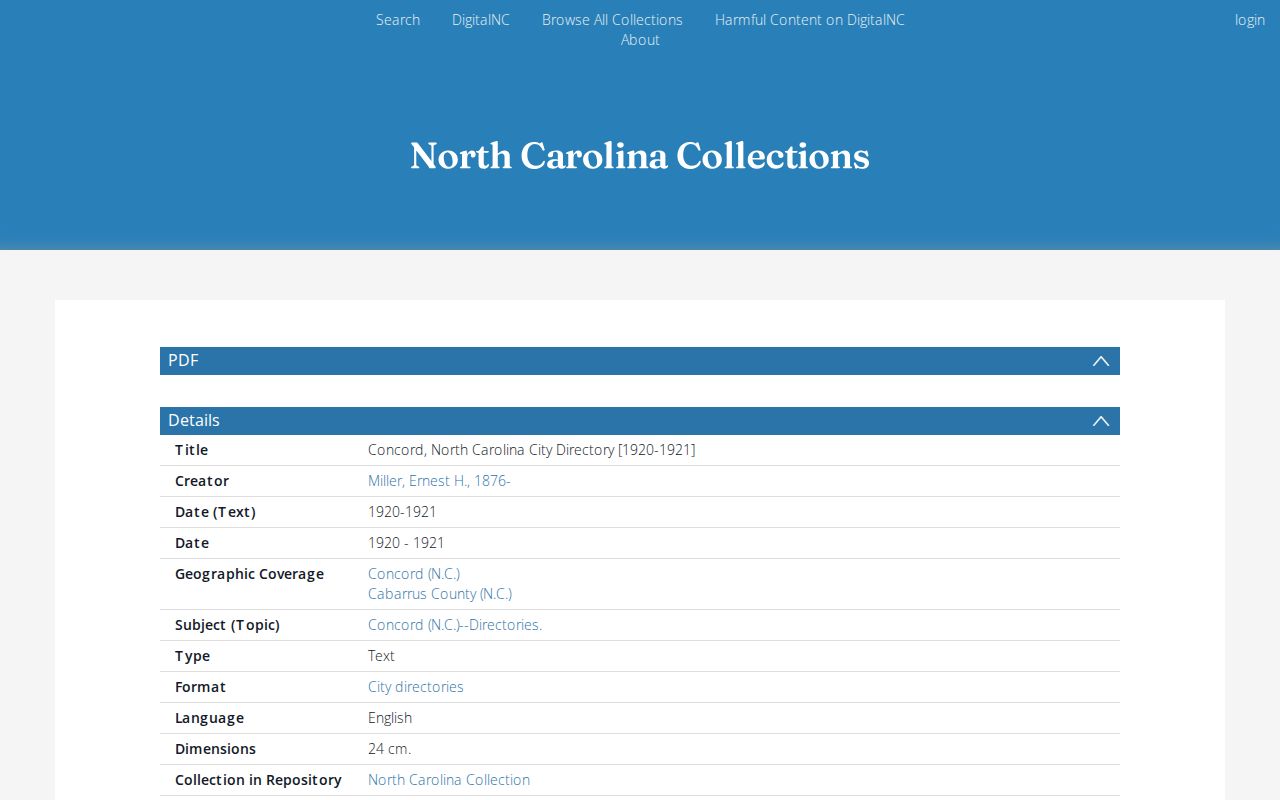
Comparing that record with the 1902 entry makes the publisher transition visible without filling the intervening years with guesses.
Cabarrus County Directory Shelf
The Cabarrus County Library Local History Resources page identifies the Lore Room at the Concord branch, 27 Union Street N. Its local material reaches back to 1750 and includes books, microfilm, and folders. Deeds, wills, court minutes, marriage records, tax lists, estate papers, county censuses, newspapers, family Bibles, church material, and cemetery readings provide context when a directory entry is brief or absent. The official description does not list every directory year or confirm a reverse-directory shelf, so a call or visit remains the appropriate way to ask about a specific volume.
Staff can help identify a usable newspaper year, an obituary file, or an older county record that sits outside a digitized directory. The Lore Room's phone number is 704-920-2061. Listed hours are Monday and Thursday 9 a.m.-8 p.m., Tuesday and Wednesday 9 a.m.-5 p.m., and Friday and Saturday 10 a.m.-6 p.m.; appointments are available. Confirm holiday hours before a visit. DigitalNC also lists 96 library-contributed yearbooks alongside directories and photographs, which makes it a helpful companion when a school or class year is known.
The Lore Room resource page names the formats and local records available at the Concord branch.
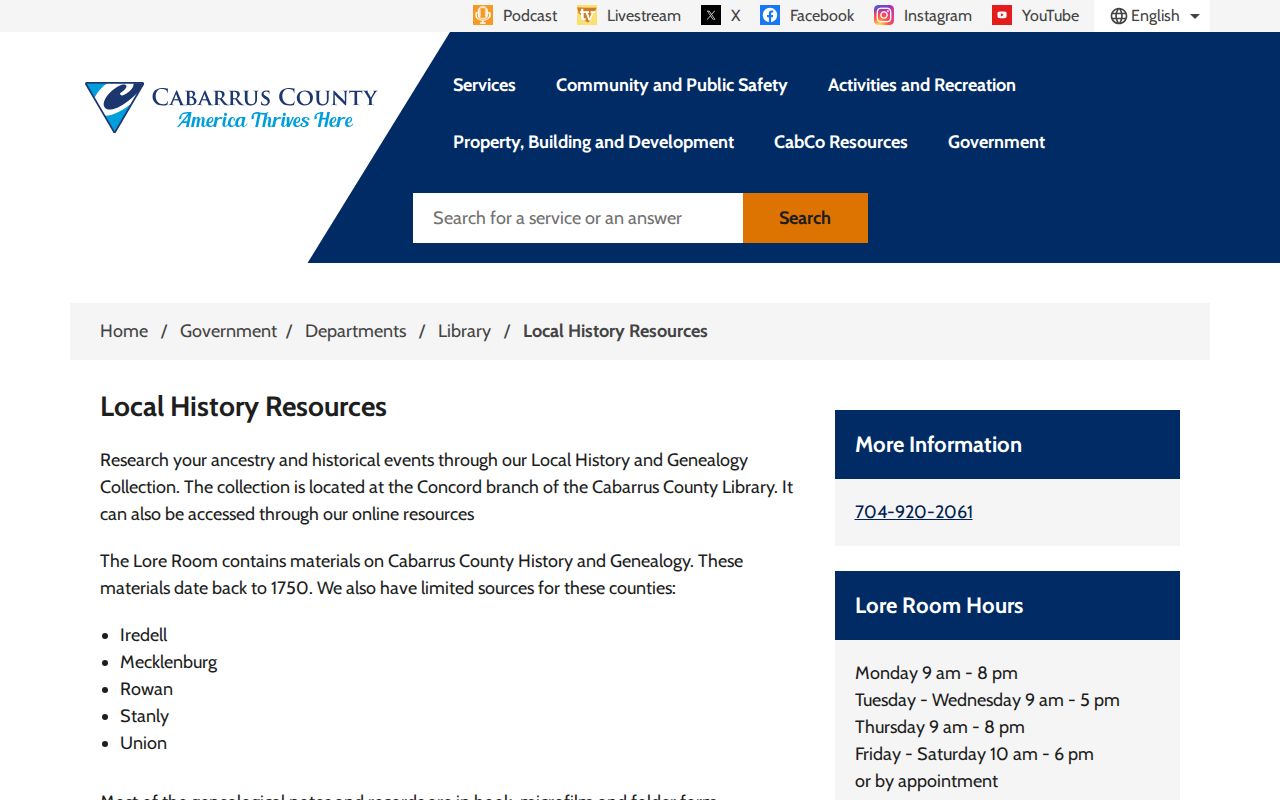
Those holdings give a family or address search a local fallback when a needed printed-volume year has not been digitized.
Reading a Cabarrus County City Directory
The inspected 1913-14 Concord scan shows how much can sit in a compact entry. A surname and given name lead the line. A spouse may appear in parentheses, and the line can add a trade, business association, residence marker, and street address. For example, the volume uses entries with a spouse in parentheses and an h marker before the address. It also uses wid for a widow or widowed person, bds for a person who boards, and abbreviations such as mill opr, clk, phys, and gen mdse. Read the key printed in the actual volume because its typography and shorthand can change.
| Name and relationship | Surname, given name, and sometimes a spouse or relationship in parentheses |
|---|---|
| Occupation | A trade or professional role, sometimes with a business association |
| Address | House number and street, commonly introduced by h for home or residence |
| Boarding notation | bds identifies a boarder, not a property interest |
| Widow notation | wid preserves a relationship clue for later cemetery, newspaper, or estate work |
| Ownership status | The inspected snippets do not establish a reliable owner mark for every Cabarrus County volume |
- Criss-cross directory
- An address-ordered section that can connect a street number with the listed household or business. A confirmed Cabarrus County shelf was not located, so ask the Lore Room and check individual scans.
- Householder index
- An alphabetical name arrangement used to locate a household before comparing the address with another source.
- Abbreviation key
- The explanatory list near the front of a volume. Photograph or note it before interpreting shorthand in that edition.
One address may recur for related people, a business, or boarders. That repetition is a research lead, not proof of every person who lived there. Compare it with census schedules, deeds, tax material, cemetery information, or a newspaper notice before forming a family conclusion.
Cabarrus County Historic Map Clues
For an old Concord address, a directory can be paired with the Library of Congress June 1911 Sanborn collection. The set has 17 sheets and records building footprints, street names, and industrial or community geography. It does not name each household. Its value is checking whether a street, lot, or building form fits the directory's address period. A later parcel map or deed description can then test whether the location is still the same place.
The 1911 map is also useful when a directory lists a mill, store, or institution near a household. Map Cabarrus aerial history begins in 1938, leaving a practical pair of visual checkpoints around the paper directory years. Neither image source substitutes for the deed record, but both can expose a mistaken assumption about an address. Old street labels and legal descriptions deserve more weight than a modern guess about the house number.
Cabarrus County Newspaper Gaps
When a desired directory year is missing, newspapers are the strongest local companion. The NC Archives guide lists title-specific Concord runs, including Concord Register from 1875-1885, Concord Sun from 1876-1882, Daily Concord Standard from 1892-1903, Concord Tribune from 1904-1910, Concord Times in several partial series, and Concord Daily Tribune runs through the 1940s. Brackets in that guide signal issue-level gaps, so a listed range does not guarantee every date.
DigitalNC's Daily Concord Standard collection provides 2,526 issues from 1892-1903 with full-text keywords, date browsing, and from/to year fields. Search a surname, an initial variant, an address, or a business name. Notices, obituaries, community items, and legal advertisements can explain an entry before or after a directory year. The Lore Room can help identify newspaper holdings that do not have the same online search route.
Cabarrus County's Smoot Record Story
The Dr. James Edward Smoot Collection at the North Carolina State Archives adds an unusually broad local layer to directory research. Its materials span 1773-1947 and include extracts from county and town records, photographs, newspapers, early-settler work, family material, schools, churches, transportation, cotton mills, gold mining, iron, and African American history. That range can explain the place names and community institutions that appear beside an address in an old volume.
Historic Cabarrus also points researchers to the Cabarrus Genealogy Society, Eastern Cabarrus Historical Society and Museum, Kannapolis History Associates, KAA MaCC, St. John's Lutheran Heritage Center, the State Archives, and DigitalNC. Those links are discovery paths rather than a promise that a particular group holds a surname file. Ask each custodian about the specific person, street, era, or collection before relying on a lead.
The Historic Cabarrus genealogy page collects local-history referrals.
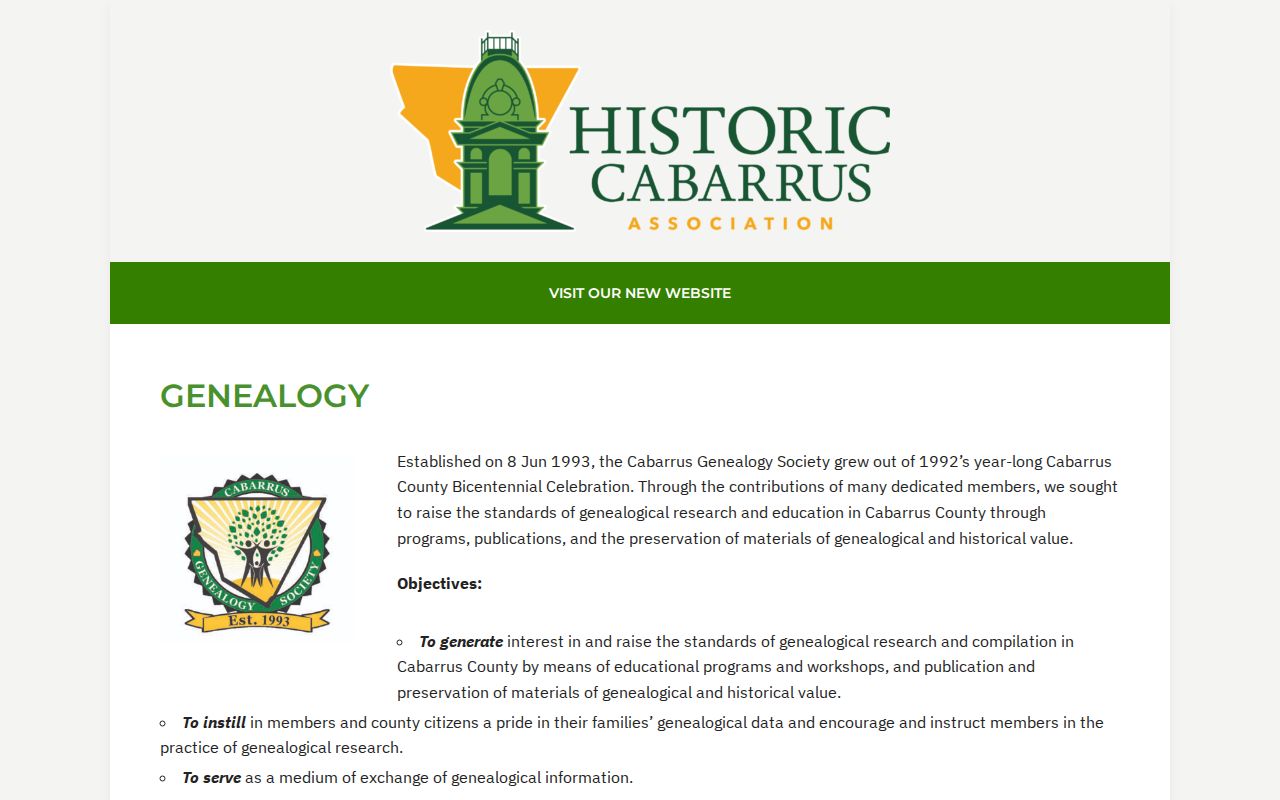
The referrals broaden directory research with local historical organizations while keeping the underlying record and its custodian clear.
Follow Cabarrus County Directory Years
Printed directory volumes work best as a sequence of dated snapshots. Begin with a known spelling, an address, or a relative's name in one confirmed volume. Record the exact initials, spouse notation, address, and abbreviations used there. Then search the next available and previous available runs. A directory can fill the years between federal census releases, while the census can supply household relationships and enumeration geography that the shorter printed line does not show.
- Find the earliest confirmed entry and copy the spelling, initials, spouse or relationship notation, address, and trade exactly as printed.
- Check the nearest earlier and later Cabarrus County directory volumes, including surname variants and abbreviated given names such as Jno.
- Compare a repeated address with a street-order section if the volume has one, but do not assume a reverse section exists for every local year.
- Pair the closest directory years with the public federal census schedules. The federal release rule is 72 years, and the Lore Room also names county census material among its holdings.
- Use a newspaper notice, cemetery lead, deed, vital record, or the Cabarrus County previous residents trail to test a move, death, estate event, or property change.
A disappearance from a directory can mean a move, a death, a changed spelling, an unlisted person, or a gap in the available volumes. The 1913-14 scan preserves spouse names in parentheses, widowed notations, boarders, mill operators, and directional street abbreviations. Search those variations and nearby addresses before treating absence as a conclusion. For a death or heir question, the NC Archives Cabarrus County estates finding aid covers 1793-1953; it is a name-and-date access point, not a substitute for the underlying estate file.