
Cabarrus County Previous Residents by Era
A backward address trail in Cabarrus County needs an era check before any name is treated as an answer. CLaRIS supplies electronic transaction detail after January 2006, while details before July 2006 may appear only on the card image. The Cabarrus County Register of Deeds holds the official recorded instruments and is the fallback for older deed books and microfilm. Historical directories provide dated household snapshots, and the Lore Room adds local deeds, tax lists, court records, censuses, maps, and family files. Federal census releases, newspapers, permits, and estates each fill a separate gap.
| Source | Years it covers | Where held | What it shows |
|---|---|---|---|
| CLaRIS electronic detail | After January 2006; pre-July 2006 detail may be image-only | Online and Register of Deeds | Property-card transactions, selected deeds, history, and owner links |
| Deed and property books | Complete online start not stated | Register of Deeds, office books, microfilm | Conveyance parties, legal descriptions, plats, and recorded instruments |
| Concord directories | 1902; selected runs from 1908 through 1964 | DigitalNC, UNC links, and Lore Room inquiry | Addresses, spouses, trades, and household clues |
| Lore Room local history | Material back to 1750 | Concord Library | Deeds, tax, court, marriage, wills, estates, census, Bible, and cemetery files |
| Federal census | Public releases follow the 72-year rule | National Archives, library databases, and related services | Household names, ages, relationships, trades, and enumeration geography |
| Concord newspapers | Title-specific 1875-1945 runs | NC Archives, DigitalNC, and Lore Room | Obituaries, moves, notices, addresses, and community references |
| Sanborn and aerial history | 1911 Sanborn; aerials from 1938 | Library of Congress and Map Cabarrus | Street, building, and site continuity, not household names |
| Estates | 1793-1953 finding aid | NC State Archives | Death, heirs, probate endpoints, and case names |
For a recent transfer, begin with the parcel, legal description, and recorded deed. For a pre-digital address question, begin with the Register, the Lore Room, or a named directory year. The research did not confirm a complete local reverse or criss-cross shelf, so do not assume that a street-order directory exists for every period. A household trail should use the available Concord directories as dated evidence and ask library staff about physical holdings.
The 1924-25 Concord directory record is one documented household snapshot for a Cabarrus County address.
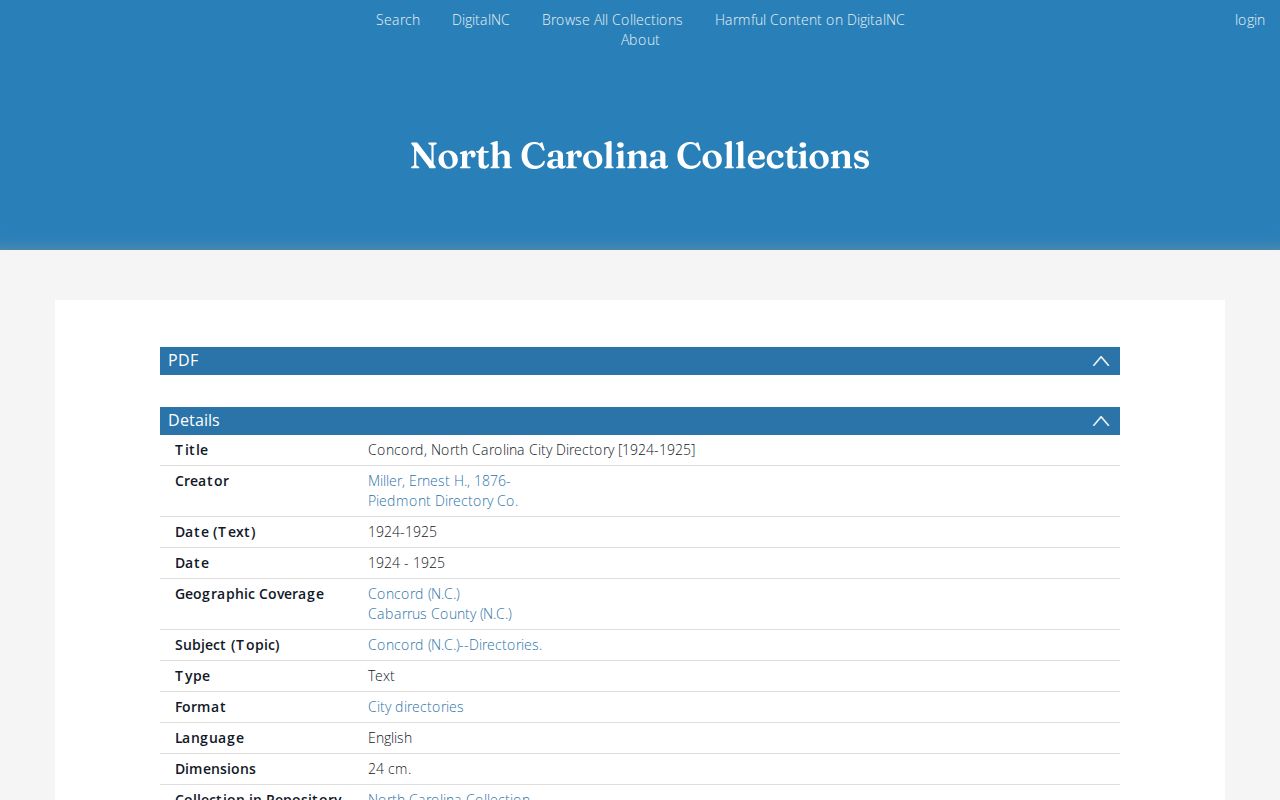
Its value is a date-specific address and name clue that can be paired with the deed and census trail, not a complete account of every past resident.
CLaRIS Time Split in Cabarrus County
CLaRIS is the county's land-record and map-card system, but its own help distinguishes electronic detail after January 2006 from older card-image material. It can search by current or prior owner, old PIN, address, property description, plat book and page, Real ID, and deed book and page. The help recommends more than one character for owner and property-description searches. PIN and old-PIN searches use exactly ten numeric digits. Its record is informational rather than an official or certified deed, so the Register of Deeds remains the authority for the original record.
This time split affects historical address research. A blank result does not prove an earlier owner or occupant never existed. Look for the card image, then carry the deed book and page, legal description, township-map-parcel identity, subdivision, or plat reference to the Register. The office is at 65 Church Street S, Concord, NC 28025, and its public counter hours are 8 a.m.-5 p.m. Recording hours are listed as 8 a.m.-4:30 p.m. Monday through Friday. The Register's main number is 704-920-2112.
| Address search | Road name is required for CLaRIS address mode; a historic address may need a legal-description check. |
|---|---|
| Owner search | Search current and prior names, then match the parcel identity instead of relying on name alone. |
| Deed book/page | Numeric navigation can open the linked deed image or record route when available. |
| Card image | Earlier details may survive in the image even when electronic transaction detail is limited. |
The North Carolina county records guide is the archive fallback for older Cabarrus County series outside the local online record.
The guide organizes county materials across land, courts, estates, tax, elections, marriage, and other series that can support a documented address trail.
Trace Cabarrus County Previous Residents Through Deeds
Ownership is the most stable part of a backward address search. Begin with the Cabarrus County Real Estate Search or Map Cabarrus to identify the current taxable owner, parcel or PIN, situs address, tax-mailing address, legal description, and any deed or plat reference shown. A taxable owner is not necessarily every owner, and a mailing address is not proof that the owner lives at the parcel. The legal description and parcel identifiers are the anchors that let the same property be recognized across older street labels and transfers.
- Search the current address and note the taxable owner, PIN or parcel number, legal description, lot or subdivision, and deed-book or plat references displayed.
- Open the CLaRIS deed, history, or transaction route and locate the current purchase deed. Record the buyer, seller, recording information, and the legal description.
- Search the seller as a prior grantee or owner, then compare the legal description, PIN, lot and block, plat, or subdivision with the same parcel.
- Repeat the transaction-to-transaction comparison backward. Treat a name match without a matching property description as a lead, not a link in the chain.
- When electronic detail stops, inspect the card image and use the Register counter, deed books, microfilm, Lore Room, or NC Archives route for the earlier instrument.
- Grantor and grantee
- The grantor is the person or entity transferring an interest. The grantee receives that interest in the recorded instrument.
- Chain of title
- The sequence of recorded transfers for the same property, matched through legal descriptions and parcel identifiers.
- Legal description
- The plat, lot, metes-and-bounds, or other recorded property description. It is often more durable than a street address for historic work.
- PIN
- A parcel identification number used in Cabarrus County systems. CLaRIS help specifies ten digits for the PIN search.
Recorded parties prove that a transfer occurred. They do not, by themselves, prove that a seller later lived at a new address. Test that separate question with a later property tax record, voter record where lawfully available, business or license material, an obituary, or probate evidence. The 1922-23 Concord directory record is one historical source for the household layer after a deed link is established.
The directory can test who was listed at an address near that year, but it should not be used as a substitute for the recorded chain of title.
Cabarrus County House-History Materials
The Lore Room does not advertise a formal house-history service, yet its named material makes a practical toolkit for a historic Cabarrus County address. The Concord branch holds local books, microfilm, and folders with deeds, tax lists, court minutes, estate papers, county census material, maps, and church, Bible, and cemetery files. Bring a parcel identifier, modern and historic street labels, known owner names, and a narrow period. Those details give staff a better way to locate a relevant folder, newspaper title, or directory item than a broad request for everything on a street.
The Lore Files, compiled by Adelaide and Eugenia Lore, are especially useful for family Bible records, church material, and cemetery readings. They may help distinguish people with the same surname or connect a house trail to a deceased family member. The collection's local scope reaches back to 1750, while its related secondary coverage is limited to Iredell, Mecklenburg, Rowan, Stanly, and Union counties. Ask for the source behind any extracted fact and preserve its title, date, and location in a research note.
Personal history use. Use past-resident research for house history, family history, estate questions, or civic curiosity. Do not use a historical address trail to stalk, harass, or harm a living person.
Cabarrus County 1911 Address Clues
The June 1911 Concord Sanborn collection at the Library of Congress contains 17 sheets. It can show whether a lot was vacant, built, industrial, commercial, or institutional at that time, along with street names and building footprints. The maps do not identify every household, so they belong beside a directory or deed rather than in place of one. A map can still expose an important mismatch, such as a directory address that falls on a block whose form does not fit the assumed property.
Map Cabarrus extends the visual sequence with historical aerial imagery back to 1938. Compare the Sanborn sheet, the earliest available aerial, a legal description, and a dated directory entry before deciding that two address references describe the same building. The research confirmed a countywide address GIS and postal-city mismatches, but it did not confirm a specific Cabarrus County street-renumbering year. Do not force an old number into a modern address. Check the deed's legal description, the map's street label, and municipal records first.
Cabarrus County Permit Dates
Permit evidence can date a change at an address when a transfer or directory leaves a gap. The county's official ArcGIS Permits 2015 layer identifies fields for PIN14, permit number, applicant name, file date, category, group, type, status, lot, owner name, address, subdivision, and a detailed description. It represents permits issued in 2015, not a complete countywide history. It can support a specific date or project lead after the parcel identity has been matched.
County OpenData appears to include historical permit services for 2004-2024, while the interactive Accela route has account features and no confirmed all-years public search coverage in the research. Use a permit date beside the deed, map, and directory evidence. A permit applicant or owner name is a connection to investigate, not proof that the person lived there. For a current permit question, confirm the live record and any public-access limit with Cabarrus County or the City of Concord.
Past Cabarrus County Households
Deeds identify parties to a transfer, but they do not fully describe a household. Directories and census schedules add the human layer. The confirmed Concord directory items include 1902, 1908, 1913-14, 1916-17, 1920-21, 1922-23, 1924-25, 1933, several 1930s and 1940s editions, and selected Hill's years to 1964. The collection details belong on the Cabarrus County city directory page. Here, use a dated entry to test who was at the address between transfers.
- Choose a directory year close to a transfer or known household event, and copy the name, initials, spouse notation, trade, and address exactly as printed.
- Check the closest earlier and later directory runs for spelling variants, abbreviated given names, nearby addresses, or a move within Concord.
- Pair the directory interval with the nearest public federal census release. The census can add household relationships, age, and enumeration geography.
- Use a newspaper notice, cemetery lead, deed, or estate file to test a move, death, inheritance, or address change suggested by the two sources.
The inspected 1913-14 volume uses h for home or residence, bds for boarders, and wid for widow or widowed. It also retains spouse names in parentheses and directional street abbreviations. Those marks can help a search, but an entry can omit people or reflect a date before publication. Do not read an absence as proof that someone was not part of the household.
The 1942 Baldwin's Concord directory record is a later household checkpoint in the documented series.
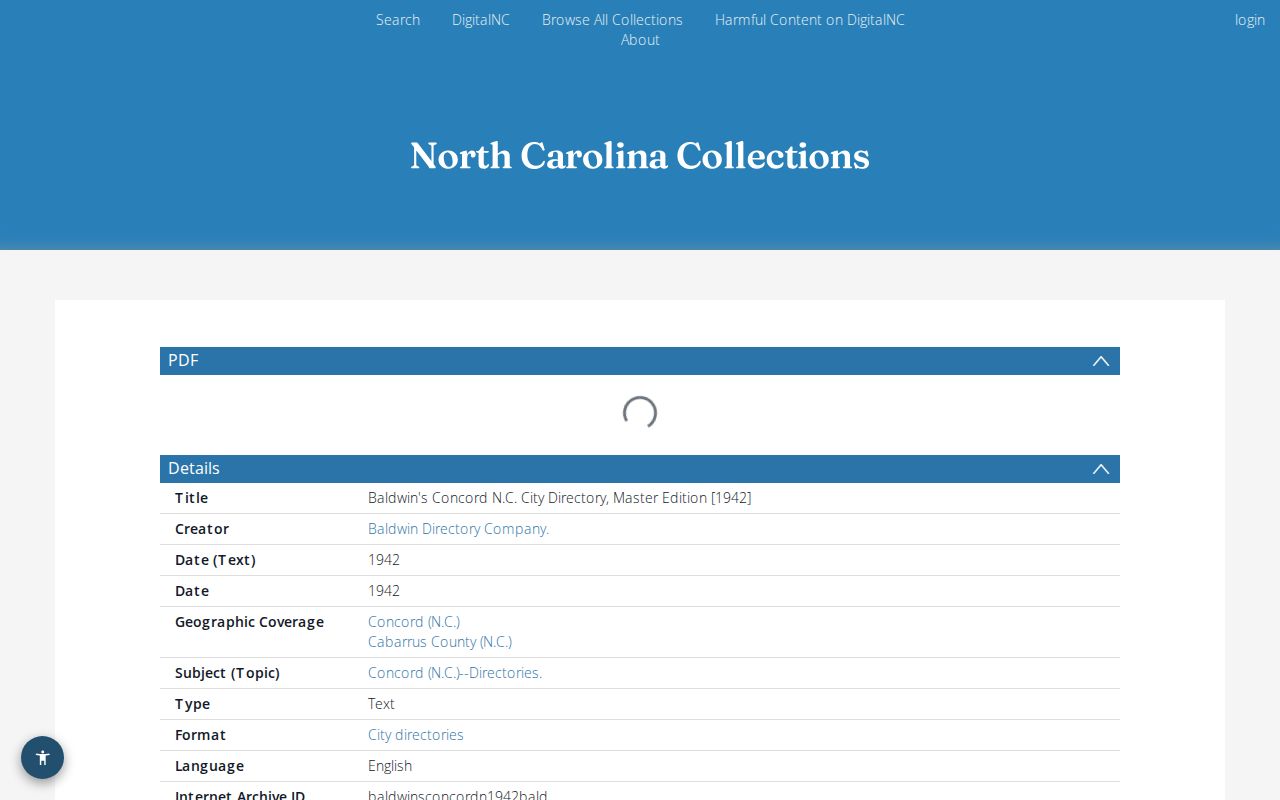
Placed between a census release and a recorded transfer, a dated directory entry can help test a household timeline without claiming a full address roster.
Cabarrus County Trail Endpoints
Newspapers, probate, cemeteries, and vital-record channels can close a past-resident trail. The NC Archives estates finding aid covers Cabarrus County cases from 1793-1953 and can identify a case name and date for an estate question. The eCourts Portal and Cabarrus County Clerk of Superior Court are the routes for current court and estate files, while the Clerk is the custodian for official copies. A newspaper obituary may supply a last address, relatives, or a funeral reference; compare it with the estate file, deed, and an appropriate vital record rather than treating one notice as conclusive.
For records before statewide birth and death registration began in late 1913, use church registers, family Bible records, cemetery readings, newspaper notices, estate papers, and county files. Marriage research has a separate Cabarrus County split: bonds from 1792-1855 are at the State Archives with local indexes, while originals from 1856 forward are local. Certified vital copies have eligibility and identification rules, so a historical lead does not create automatic access to a certificate.
A dead end can be useful. Record the last confirmed owner, occupant clue, source title, date, page or book reference, and the access channel already checked. That detail makes a Register visit, Lore Room appointment, archive request, or later search reproducible. It also avoids attaching a later person to the wrong house when Cabarrus County's older records use a different street label or only a legal description.